

The Skunk Under the Shed: Managing Persistent Skunk Smell
Posted on: March 31, 2026 in General Industry
A Practical Exercise in Risk Management
Skunk smell is more than an inconvenience. It is a practical lesson in hazard identification, control reliability, and consequence severity.
Risk management theory covers hazard identification, control reliability, and consequence severity. However, these principles also apply when a family of skunks moves under your shed.
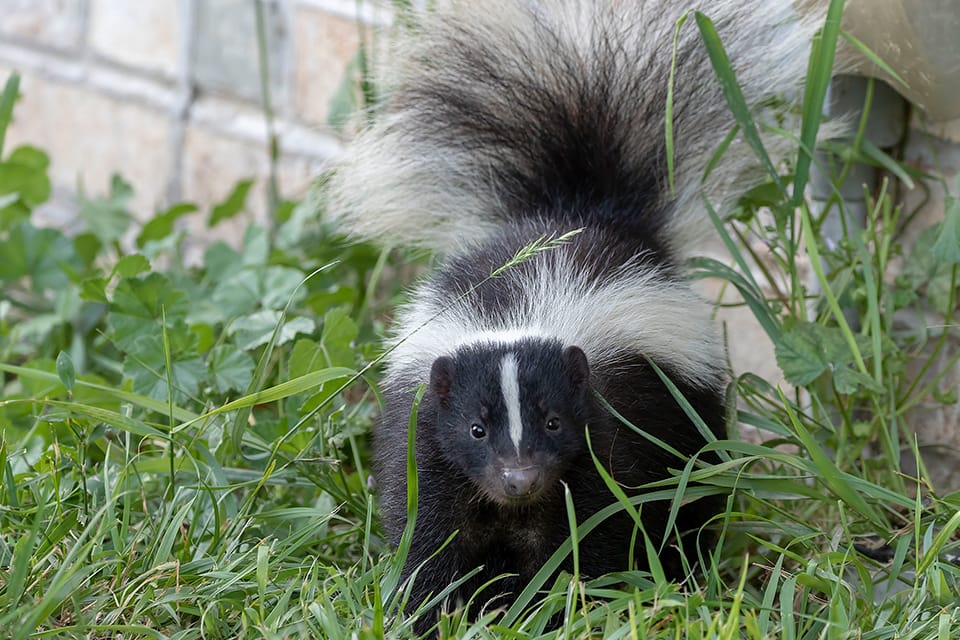
In my case, the shed was 10′ × 12′. The skunks had clearly chosen it as long-term housing. The shed was not moving. Therefore, the hazard was unlikely to relocate either.
Hazard Identification
The first indication of a problem came when my dogs encountered the skunks. Twice.
Anyone familiar with skunk spray knows it is not just an odor. Instead, it is a full atmospheric onslaught. Moreover, it is remarkably persistent.
The first incident occurred at approximately 4:00 a.m. After being sprayed, the dogs were let back into the house. This unintentionally created an enclosed environment for skunk smell to spread rapidly.
Within thirty minutes, the entire household woke up. No alarms were triggered. No alerts were issued. The smell alone was sufficient.
What followed was a half-awake investigation into the source. Eventually, the dogs were identified as the cause.
A brief incident review confirmed the root cause involved both skunks and dogs. However, corrective actions for the dogs proved difficult.
It took nearly a week and a half before the house no longer smelled like skunk.
Recurring Exposure
The second encounter reinforced a key principle. Past events do not always change future behavior.
The dogs encountered the skunks again. This time, the incident occurred in the evening. Our daughter let them back inside.
However, corrective action was faster. My wife immediately began washing the dogs outside.
The neighbors were likely aware of the situation, although from a safe distance.
Despite this response, the dogs showed no improvement in future risk assessment. Lessons learned were shared informally. Still, compliance remained inconsistent.
Defining the Risk
At this point, several facts were clear:
- The shed was 10′ × 12′
- It was not moving
- Multiple skunks were present
- The dogs repeatedly engaged the hazard
In risk terms, this was a persistent hazard with recurring exposure potential. Therefore, control measures were necessary.
Initial Control Efforts
Like many organizations, I initially chose to manage the situation internally.
Through trial, error, and questionable judgment, I captured three skunks myself. This created a brief sense of success.
However, it also revealed an important reality. Removing skunks does not eliminate the problem. Instead, it often confirms that more skunks exist.
Defensive Strategy
The defensive approach evolved into three main actions:
- Keep the dogs away from the shed
- Assume the skunks would leave on their own
- Attempt removal personally
Of these, only the first acted as a true barrier. The second was a hopeful assumption. The third became an ongoing experiment.
Barrier Performance and Skunk Smell Control
Risk models often describe incidents as failures across multiple layers. In this case, barriers were weak.
Keeping the dogs away required consistent compliance. Unfortunately, the stakeholders showed little interest in following that control.
The assumption that skunks would relocate proved unreliable. Evidence did not support this belief.
Personal removal efforts addressed individual animals. However, they did not eliminate the root cause. As a result, skunk smell remained a recurring issue.
This highlights a common problem. Activity should not be mistaken for effective control.
Consequence Realization
After capturing the third skunk, another lesson became clear. Even successful controls can leave lasting consequences.
Despite precautions, I needed three showers afterward. Still, traces of skunk smell seemed to linger.
Even now, I occasionally detect it. No one else notices. This could be residual exposure or simple overexposure to the situation.
The available evidence remains inconclusive.
Escalation to Specialists
Eventually, a familiar conclusion emerged. Some hazards persist despite best efforts.
Some controls are imperfect. And some situations exceed do-it-yourself capabilities.
In this case, the solution was engaging a professional wildlife removal service. Because while frameworks are useful, they do not eliminate skunk smell from a shed turned skunk residence.
Final Reflection
Risk management often appears straightforward in theory. However, real situations are rarely tidy.
Hazards persist longer than expected. Controls behave differently under real conditions. Consequences linger.
Ultimately, the most effective control is sometimes recognition. Not every problem requires another internal solution.
Sometimes, the right move is calling someone equipped to handle skunks under sheds and the skunk smell that comes with them.
About the Author
Josh Ortega, Vice President, Global HSE & Sustainability, formerly served as the Chairman of SafelandUSA and an Executive board member for the National STEPS Network. Before joining Veriforce as Vice President of SSP, Josh was with BHP for 18 years. During his time with BHP, Josh worked in operations, human resources, health, safety, environment, and community, primarily focused on contractor management. Josh’s extensive experience in oil and gas production, drilling, completions, well interventions, and construction across the United States provides a robust platform to help industry partners enhance safety and bring workers home safe.