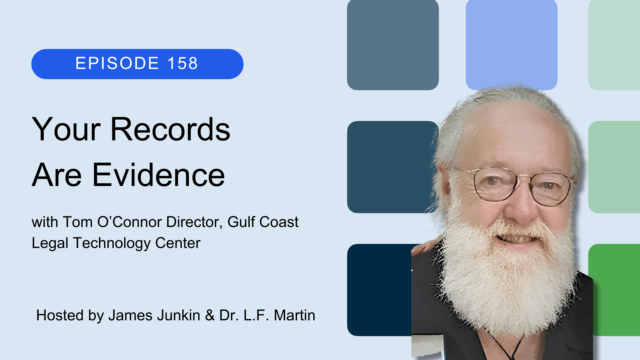
Your Safety Records Are Evidence: Data Mapping and E-Discovery with Tom O’Connor | Risk Matrix Episode 158
THE RISK MATRIX Cutting-edge podcast on occupational safety and risk management. Hosted by industry titans: JAMES JUNKIN, MS, CSP, MSP,…


Letters of Interpretation (LOIs) play a critical role in how OSHA expectations are understood and applied in the workplace. OSHA’s LOIs explain how existing standards apply to real-world conditions. Importantly, LOIs do not create new requirements. Instead, they clarify enforcement intent and signal how OSHA will evaluate compliance in practice.
For safety professionals, LOIs are especially valuable where regulatory language lags behind modern technology or evolving work practices. They help translate broad standards into actionable guidance. When used correctly, LOIs serve as a practical reference point for aligning safety programs with OSHA’s current thinking.
LOIs matter because they reduce uncertainty. Many OSHA standards rely on flexible terms like “feasible” or “effective,” which can create compliance risk. LOIs help close that gap by explaining OSHA’s position in specific scenarios. As a result, safety leaders can design programs that better withstand inspection scrutiny.
This clarity is even more important following recent legal developments. In Loper Bright Enterprises v. Raimondo (2024), the U.S. Supreme Court limited judicial deference to agency interpretations. Courts now rely more heavily on statutory and regulatory text. While LOIs remain persuasive, employers must ground compliance decisions firmly in the CFR.
Still, LOIs continue to shape enforcement expectations. OSHA inspectors use them to promote consistent application of standards across industries. Although citations must cite the CFR, LOIs often explain how OSHA believes the regulation applies. For employers, ignoring LOIs can increase enforcement risk.
Another reason LOIs matter is transparency. OSHA’s December 2025 release included seven LOIs addressing recurring compliance questions. These topics included confined spaces, recordkeeping, powered industrial trucks, carcinogen controls, hearing conservation, and stairway design. Collectively, the LOIs reinforced a consistent message. OSHA supports clarity but does not relax core safety obligations.
For employers under state plans, LOIs remain relevant. State programs must be at least as effective as federal OSHA. As a result, federal LOIs often influence state-level enforcement decisions, even if they are not formally adopted.
Technology frequently outpaces regulation. LOIs help bridge that gap. Several recent LOIs addressed remote training and digital recordkeeping. OSHA acknowledged that technology can support compliance. However, it emphasized that performance requirements still apply.
For powered industrial trucks, remote instruction may satisfy knowledge components. However, hands-on evaluations by a qualified person remain mandatory. For recordkeeping, software-generated OSHA Forms 300 and 300A are acceptable. Yet all required fields must be captured, summaries must be certified, and records must be accessible during inspections.
These LOIs reinforce a broader principle. Innovation is welcome only when it delivers the substance of compliance. Employers cannot rely on technology alone. They must demonstrate that outcomes meet regulatory intent.
Documentation appears repeatedly throughout OSHA LOIs. Employers are expected to maintain clear evidence of compliance. This includes hazard analyses, exposure monitoring, isolation verifications, and training evaluations.
Strong documentation supports compliance in two ways. First, it demonstrates alignment with the CFR. Second, it shows consistency with LOI guidance. Together, these elements strengthen defensibility during inspections or legal challenges.
Integrating LOIs into safety management systems can materially reduce risk. When LOIs inform procedures, audits, and training, organizations move from reactive compliance to proactive control.
The December 2025 LOIs clarified several important compliance questions. For permit-required confined spaces, OSHA explained that draining water-filled pipes before entry depends on a documented hazard evaluation. If rupture hazards remain, controls like blanking or blinding are still required.
For recordkeeping, OSHA reaffirmed that COVID-19 cases remain recordable when work-related under Part 1904. Serious injury and fatality reporting thresholds remain unchanged.
LOIs addressing powered industrial trucks confirmed that remote training can address classroom components. However, hands-on performance evaluations are still required under 29 CFR 1910.178.
OSHA also clarified that employers may use software equivalents for Forms 300 and 300A. These systems must capture all required data, allow certification, support posting, and provide timely inspector access.
In carcinogen control, LOIs addressed benzene and 1,3-butadiene standards. Leak-tight valves may qualify as engineering controls if they demonstrably reduce exposure. Employers must support this claim with monitoring data and maintenance records.
For hearing conservation, OSHA explained that audiometric testing for workers with cochlear implants requires individualized assessment. Consultation with audiologists is critical to ensure meaningful protection.
Finally, stairway design LOIs emphasized dimensional uniformity. OSHA made clear that one deviation cannot be offset by another. Each requirement must be met independently.
OSHA uses LOIs as interpretive guidance during enforcement. Although inspectors must cite the CFR, LOIs inform how standards are evaluated. The Field Operations Manual instructs compliance officers to consider LOIs when assessing conditions.
When workplace conditions closely mirror an LOI scenario, inspectors may reference that LOI to explain expectations. However, the legal basis for any citation remains the regulatory text. Understanding this distinction is essential for compliance planning.
Employers can also use LOIs defensively. The most effective approach anchors arguments in the CFR and supports them with relevant LOIs. This strategy shows alignment with both regulatory text and OSHA’s interpretation.
For confined spaces, hazard analyses and isolation documentation consistent with LOIs can strengthen defenses. For powered industrial trucks, records showing hands-on evaluations alongside remote instruction support compliance. In recordkeeping cases, proof that software systems meet all regulatory requirements can resolve disputes.
For hearing conservation, audiologist recommendations demonstrate individualized compliance. In stairway cases, measurement records showing dimensional uniformity provide objective evidence.
Used correctly, LOIs can help employers explain why their approach meets OSHA expectations.
Ultimately, OSHA LOIs are not enforceable rules, but they play a decisive role in how compliance is evaluated, defended, and sustained. Translating LOI guidance into day-to-day practice requires more than awareness; it demands systems, data, and expertise that connect regulatory intent to real-world execution. This is where many organizations struggle: not with understanding what OSHA is saying, but with operationalizing it consistently across sites, contractors, and jurisdictions.
Veriforce helps organizations bridge that gap. Through integrated contractor management, training, compliance documentation, and analytics, Veriforce enables employers to align safety programs directly with OSHA’s regulatory language while incorporating LOI guidance into hazard evaluations, training validation, recordkeeping, and inspection readiness. Whether documenting hands-on PIT evaluations, managing confined space controls, maintaining defensible OSHA 300 records, or demonstrating the effectiveness of engineering controls, Veriforce solutions provide the structure and traceability inspectors expect to see.
Beyond technology, Veriforce Expert Services support organizations in interpreting LOIs, stress-testing programs against enforcement expectations, and strengthening compliance defensibility before an inspection or citation occurs. By combining regulatory expertise with scalable systems, organizations can move from reactive compliance to proactive risk management, protecting workers, reducing exposure, and building resilience in an evolving regulatory landscape.
In an environment where OSHA interpretation, legal scrutiny, and operational complexity continue to converge, leveraging both informed regulatory insight and purpose-built safety solutions is no longer optional. It is essential to sustain compliance with confidence.
James A. Junkin, MS, CSP, MSP, SMS, ASP, CSHO is the chief executive officer of Mariner-Gulf Consulting & Services, LLC and the chair of the Veriforce Strategic Advisory Board and the past chair of Professional Safety journal’s editorial review board. James is a member of the Advisory Board for the National Association of Safety Professionals (NASP). He is Columbia Southern University’s 2022 Safety Professional of the Year (Runner Up), a 2023 recipient of the National Association of Environmental Management’s (NAEM) 30 over 30 Award for excellence in the practice of occupational safety and health and sustainability, and the American Society of Safety Professionals (ASSP) 2024 Safety Professional of the Year for Training and Communications, and the recipient of the ASSP 2023-2024 Charles V. Culberson award. He is a much sought after master trainer, keynote speaker, podcaster of The Risk Matrix, and author of numerous articles concerning occupational safety and health.
References
Library of Congress. (2024). Loper Bright Enterprises v. Raimondo and the future of agency interpretations of law (CRS Report R48320). https:// www.congress.gov/crs-product/R48320
Occupational Safety and Health Administration. (2025a). Letters of Interpretation. https://www.osha.gov/laws-regs/interpretations
Occupational Safety and Health Administration. (2025b). US Department of Labor issues 7 letters of interpretation addressing workplace safety, health requirements. https://www.osha.gov/news/newsreleases/osha-national-news-release/20251210
Occupational Safety and Health Administration. (2025c). Software used to generate equivalent OSHA Forms 300 and 300A. https://www.osha.gov/recordkeeping/forms
Occupational Safety and Health Administration. (2025d). OSHA Field Operations Manual. https://www.osha.gov/fom
Surma, J. D. (2025, December 17). OSHA’s seven letters of interpretation in December 2025: Coal or candy for employers? Ogletree Deakins. https://ogletree.com/insights-resources/blog-posts/oshas-seven-letters-of-interpretation-in-december-2025-coal-or-candy-for-employers/

THE RISK MATRIX Cutting-edge podcast on occupational safety and risk management. Hosted by industry titans: JAMES JUNKIN, MS, CSP, MSP,…
THE RISK MATRIX Cutting-edge podcast on occupational safety and risk management. Hosted by industry titans: JAMES JUNKIN, MS, CSP, MSP,…
We’ll send you practical and insightful supply chain risk management info that can benefit your business. Plus, important company updates that keep you in the loop.