


Fatal Risk, Mobility, and the Design Boundaries of Safety Management Systems
Posted on: February 26, 2026 in General Industry

Safety management systems were originally designed to control hazards generated directly by work tasks and equipment. However, workplace fatalities are materially influenced by mobility, contractor integration, and external social factors. These domains were not architected to be managed at scale within traditional system boundaries.
In 2024, 5,070 workers died from occupational injuries in the United States. The fatality rate was 3.3 per 100,000 full-time equivalent workers (Bureau of Labor Statistics [BLS], 2026). Annual totals fluctuate modestly. Yet fatal injury counts have remained clustered near 5,000 per year across recent years (BLS, 2026).
More revealing than total counts is the composition of fatal risk.
Transportation incidents accounted for 1,937 deaths in 2024. This represents 38.2 percent of all occupational fatalities (BLS, 2026). Falls, slips, and trips resulted in 844 fatalities. Violent acts accounted for 733 deaths, including 470 homicides. Exposure to harmful substances resulted in 687 fatalities, including 410 drug and alcohol overdoses (BLS, 2026).
These categories consistently represent the structural center of fatal exposure.
Multi-Year Structural Fatality Pattern (CFOI)
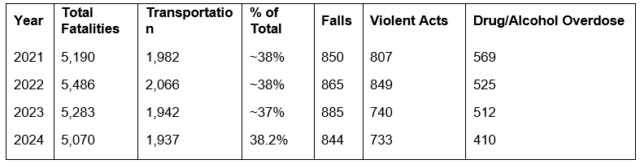
Source: Bureau of Labor Statistics, Census of Fatal Occupational Injuries (BLS, 2026).
Across multiple years, several patterns persist.
- Total fatalities remain near 5,000 annually.
- Transportation consistently represents roughly 37 to 38 percent of all deaths.
- Falls remain a dominant high-energy exposure category.
- Violent acts remain materially significant.
- Drug and alcohol overdoses remain embedded within occupational fatality totals.
Therefore, the persistence of these categories suggests structural exposure concentration rather than episodic variation.
The Original Architecture of Safety Management Systems
Modern safety management systems are designed to control hazards generated directly by work tasks and equipment. Their design logic reflects several core assumptions:
- Hazards originate within defined operational processes.
- Controls are engineered, procedural, or administrative.
- Risk is primarily energy transfer within an employer-controlled environment.
- Performance measurement emphasizes injury frequency.
Traditional safety management systems include transportation policies, fleet standards, fall protection programs, and other high-risk controls. Within employer-bounded environments, these controls remain essential and effective for managing task-level hazards.
However, dominant fatal categories reflect exposure domains influenced by factors extending beyond employer boundaries.
For example, transportation fatalities occur during work activity. Yet they are materially shaped by mobility patterns, public roadway exposure, labor economics influencing fatigue, contractor logistics, and cross-employer scheduling pressures (BLS, 2026).
Similarly, drug and alcohol overdoses occur at work. However, they reflect impairment dynamics influenced by broader public health conditions and workforce vulnerability.
In addition, violent acts arise within workplaces. Yet they are influenced by public-facing exposure, social instability, and conditions originating outside a single employer’s operational control.
These risks intersect with work. They are not purely external. However, they are not generated exclusively by task-level hazard mechanics within an employer’s perimeter.
Traditional safety management systems were architected around employer-bounded hazard control. In contrast, modern fatal exposure frequently crosses that boundary.
This is not a failure of practitioners. Rather, it is a design limitation.
Contractor Maturity Implications
This structural exposure pattern has direct implications for contractor maturity models.
If dominant fatal risk categories concentrate in mobility-intensive, multi-employer, and subcontracted environments, contractor evaluation cannot rely primarily on lagging injury metrics or documentation completeness.
Instead, maturity must reflect an organization’s capability to manage cross-organizational fatigue risk, fleet exposure, supervision density, and assurance intensity in high-consequence domains.
In this context, contractor maturity is not an administrative designation. It is an indicator of structural fatal risk control capacity.
Metric Misalignment
Total recordable injury rates remain widely used indicators of safety performance. They capture injury frequency. However, they were not designed to model fatal exposure concentration.
Transportation fatalities, violent acts, and overdose events do not reliably correlate with minor injury trends. In fact, dominant fatal categories persist regardless of fluctuations in lower-severity injury metrics.
When performance measurement is anchored primarily to frequency indicators, organizations may improve recordable injury rates while leaving structural fatal exposure largely unaffected.
This does not render frequency metrics useless. Instead, it clarifies their scope.
Frequency reduction and fatal risk control are not interchangeable constructs.
Implications for Governance
The multi-year persistence of transportation, falls, violent acts, and substance-related fatalities demonstrates that these are structural features of the occupational risk landscape (BLS, 2026).
For executive leadership and boards, this requires disciplined inquiry:
- Where does mobility exposure reside within our operations?
- How does contractor integration influence fatigue and supervision?
- Does assurance intensity align with high-consequence exposure categories?
- Are injury frequency improvements being conflated with fatal risk control?
Compliance confirmation remains necessary. However, it does not guarantee structural fatal risk reduction.
Therefore, architectural alignment between dominant exposure categories and control strategy is required.
Conclusion
Workplace fatalities are materially influenced by mobility, contractor integration, public roadway exposure, impairment dynamics, and workforce vulnerability. These domains were not originally architected to be fully managed at scale within traditional safety management systems.
National fatality data demonstrate persistent concentration in transportation, falls, violent acts, and drug and alcohol overdose categories across multiple years (BLS, 2026). These exposures are shaped by mobility, workforce structure, contractor density, and societal conditions intersecting with work.
Traditional safety management systems remain foundational for controlling operational hazards within employer-bounded environments. However, their original design boundaries do not fully encompass the broader exposure ecology influencing fatal outcomes.
Meaningful reduction in fatal risk requires systems that align assurance intensity with where exposure structurally concentrates, not solely where traditional hazards are most visible.
Fatal exposure patterns have remained persistent.
Accordingly, system architecture must evolve.
About the Author
Josh Ortega is Vice President of Global HSE & Sustainability at Veriforce. With over 30 years of experience, he builds technology-enabled systems that prevent serious incidents and strengthen learning. He contributes to industry guidance and speaks widely on contractor risk, data-driven insights, and the future of safety leadership.
References
Bureau of Labor Statistics. (2026, February 19). National census of fatal occupational injuries in 2024 (USDL-26-0230). U.S. Department of Labor. https://www.bls.gov/news.release/pdf/osh.pdf
Bureau of Labor Statistics. (2026). Injuries, illnesses, and fatalities (IIF) program. U.S. Department of Labor. https://www.bls.gov/iif/