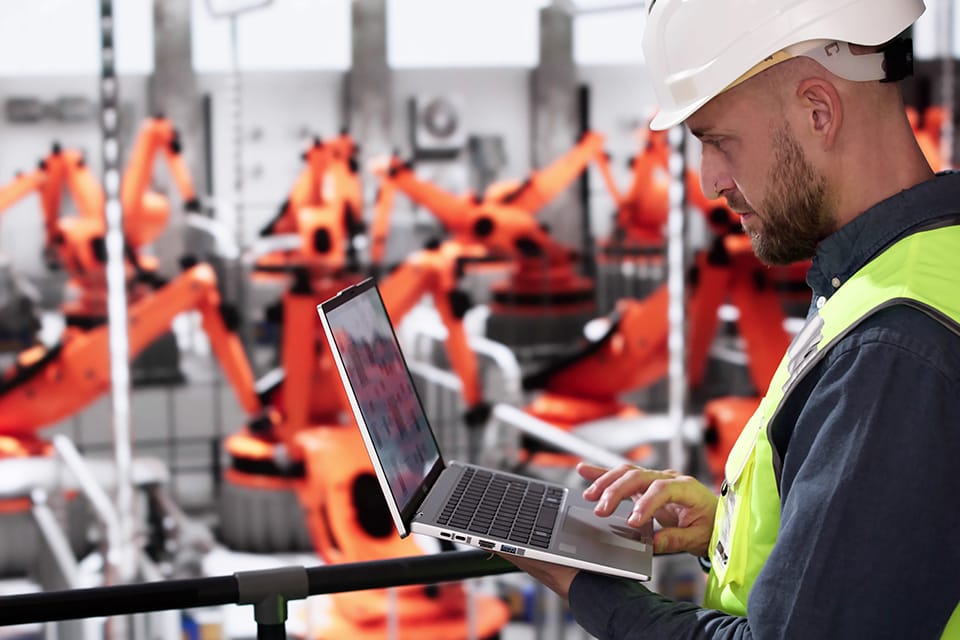
Machine guarding rules meet a hard test when robots and humans share space. Robotics, AI, and automation are changing how work gets done across industries. These systems often require humans nearby, creating safety challenges older guarding concepts never anticipated. Safety professionals must now apply longstanding rules to entirely new operational realities.
Advanced robotics often require human interaction during commissioning, programming, calibration, and troubleshooting. Unlike traditional machinery behind fixed barriers, robots frequently need workers close by while systems remain active. These interactions help verify precision, collect performance data, and ensure proper operation. As a result, employers face hard questions about balancing operational necessity with OSHA’s expectations for machine guarding.
Many organizations mistakenly assume they can skip safeguards that slow production down. OSHA, however, doesn’t allow noncompliance simply because it’s inconvenient or costly. Employers must implement feasible safeguards using the hierarchy of controls. Only in narrow circumstances can compliance truly be considered infeasible.
This is where the infeasibility defense becomes relevant to machine guarding cases. Though frequently discussed, the defense remains widely misunderstood by employers and practitioners alike. It isn’t a loophole; it’s a narrow doctrine requiring objective, contemporaneous evidence. Success depends on documented analysis long before any OSHA inspection occurs.
What Is the Machine Guarding Infeasibility Defense?
The infeasibility defense is a narrow doctrine recognized by the OSH Review Commission. It applies when compliance with a specific requirement isn’t truly possible. Importantly, it doesn’t eliminate an employer’s duty to protect workers at all.
Machine guarding cases most often arise under 29 CFR 1910.212. This standard requires guarding methods that protect employees from moving machine parts, rotating components, and points of operation. OSHA generally presumes engineering controls, like barrier guards or interlocked gates, are both feasible and preferred over other alternatives.
The defense addresses situations where prescribed protection can’t function as intended. A guard might block a needed inspection, or a sensor might halt calibration constantly. The question becomes whether that specific protection can reasonably be implemented.
Courts have established that the burden of proof rests entirely with employers. General assertions or after-the-fact explanations rarely persuade regulators or judges. Instead, employers must present detailed engineering analyses and documented risk evaluations.
The analysis is also highly fact-specific to each situation. A safeguard infeasible in one environment may work perfectly well elsewhere. For robotics, this often means examining motion, reach, and human-interaction points closely.
Demonstrating Infeasibility
The first element requires employers to prove compliance isn’t feasible at all. This can involve either technological or economic infeasibility, though technological claims are far more common. Either way, the standard of proof remains substantial and objective.
Technological infeasibility exists when equipment or task requirements make compliance self-defeating. In robotics, this may happen when workers must enter a robot’s workspace for teaching, calibration, or verification. However, OSHA still expects detailed engineering analyses and operational testing supporting this conclusion, not mere assertions.
Economic infeasibility carries an even higher burden of proof. Employers must show compliance would threaten continued business operations entirely, not merely reduce profits. Courts have historically required extensive financial documentation before accepting this kind of argument at all.
Infeasibility must always be demonstrated through evidence, never simply claimed. OSHA expects facts, calculations, and expert analyses supporting an employer’s position. Evaluations of workspace geometry and stopping distances often prove essential here.
Exhausting Feasible Alternatives
Proving infeasibility is only half the employer’s overall burden. The second element requires proof that all alternative protections were evaluated. This reflects OSHA’s ongoing commitment to the hierarchy of controls.
Employers must conduct a disciplined, documented search for alternative controls. This may include reduced-speed modes, safety-rated monitored stops, safety scanners, light curtains, or enhanced supervision. Each alternative should be judged on its ability to reduce risk while still preserving the work’s necessary functionality.
Documenting why alternatives were selected or rejected matters greatly here. OSHA expects engineering calculations, testing results, and validation studies as evidence. This shows alternatives were assessed using a defensible, structured methodology.
Ultimately, employers must show no feasible alternative offers equivalent protection. The defense often depends less on what couldn’t work and more on the documented effort undertaken. Organizations that systematically document their search for alternatives strengthen their position considerably, since this shows genuine, sincere risk reduction.
A Robotics Example
Consider a company testing a teleoperated robotic platform indoors to gather machine-learning data. Technicians must periodically enter the workspace to reposition objects, recalibrate sensors, and troubleshoot issues. These activities are essential to development and cannot be completed remotely.
Fixed barriers might seem like an obvious machine guarding solution here. However, such barriers would prevent access exactly when interaction is required. A presence-sensing device could similarly disrupt necessary calibration functions constantly.
Before claiming infeasibility, the employer must evaluate real alternatives thoroughly. This includes reduced-speed modes, software motion limits, and enhanced operator training. Each decision must be tested, documented, and supported by objective evidence.
If barriers truly can’t work and alternatives have been maximized, the defense may hold. The key factor isn’t the robotics technology itself. It’s the quality of evidence and effort behind worker protection decisions.
Why Documentation Decides Every Case
In nearly every infeasibility case, documentation becomes the deciding factor. Employers rarely win by simply claiming compliance was impossible. They win by producing evidence of comprehensive hazard analysis and tested alternatives.
Effective documentation includes risk assessments, engineering evaluations, design reviews, and stopping-time studies. Robotics cases add motion analyses, reach calculations, functional safety verification, and maintenance logs. Together, these create a defensible record showing systematic, evidence-based risk reduction efforts.
Documentation ultimately proves good faith to regulators reviewing a case after the fact. An undocumented control evaluation may be treated as though it never actually occurred. The strongest defense is therefore built long before an OSHA inspection ever begins, through rigorous analysis and accurate recordkeeping.
Conclusion
The infeasibility defense holds a unique place in occupational safety law. It recognizes that some tasks resist conventional machine guarding methods entirely. Still, it’s never treated as an exception to the duty to protect workers from harm.
For robotics employers, understanding this defense matters more every year. Human-robot interaction and calibration work don’t fit neatly into old guarding concepts. OSHA’s expectation, however, remains unchanged: reduce risk to the greatest extent feasible.
The defense rests on two elements that are simple in concept. First, prove that compliance is technologically or economically infeasible. Second, prove every feasible alternative was identified and implemented where possible.
Ultimately, the strongest infeasibility defense is a rigorous safety management process. Comprehensive risk assessments, engineering evaluations, and documented testing show real, sustained commitment to protection. The goal was never avoiding requirements, but achieving the highest protection realistically attainable given the work’s actual conditions.
About the Author
James A. Junkin, MS, CSP, MSP, SMS, ASP, CSHO is the chief executive officer of Mariner-Gulf Consulting & Services, LLC and the chair of the Veriforce Strategic Advisory Board and the past chair of Professional Safety journal’s editorial review board. James is a member of the Advisory Board for the National Association of Safety Professionals (NASP). He is Columbia Southern University’s 2022 Safety Professional of the Year (Runner Up), a 2023 recipient of the National Association of Environmental Management’s (NAEM) 30 over 30 Award for excellence in the practice of occupational safety and health and sustainability, and the American Society of Safety Professionals (ASSP) 2024 Safety Professional of the Year for Training and Communications, and the recipient of the ASSP 2023-2024 Charles V. Culberson award. He is a much sought after master trainer, keynote speaker, podcaster of The Risk Matrix, and author of numerous articles concerning occupational safety and health. He is a proud veteran of the United States Navy and a strong advocate for veteran causes.