

Heat Stress and Hydration Science for Oil & Gas Crews
Posted on: September 24, 2026 in Oil & Gas
By: James Junkin
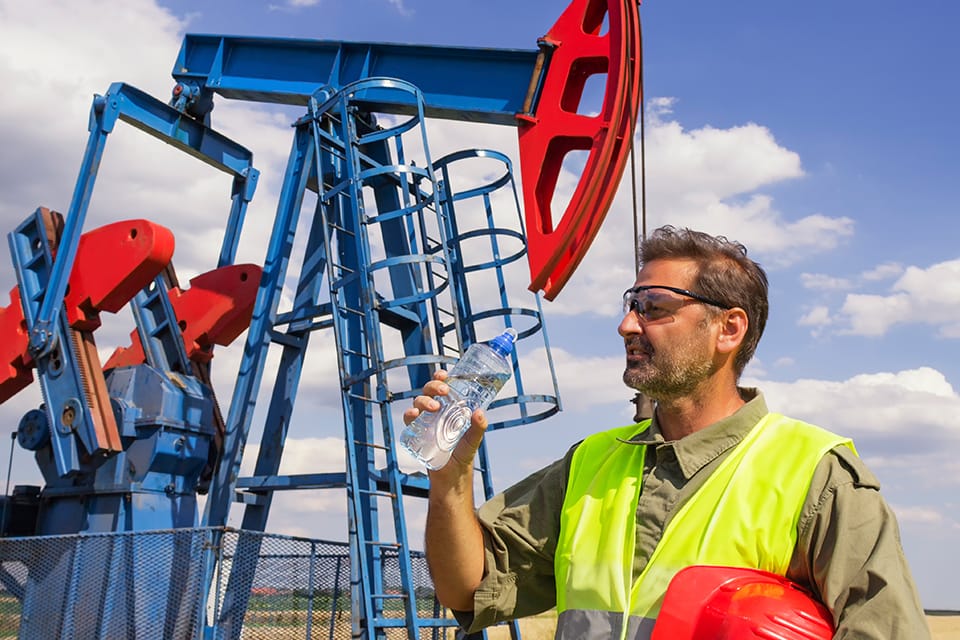
Heat stress remains one of the most poorly managed hazards in oil and gas work. Crews routinely work ten- and twelve-hour shifts in flame-resistant clothing, under direct sun, near heat-radiating equipment. Under those conditions, fluid and electrolyte balance isn’t a wellness topic. It’s a safety control.
The guidance most crews learned is now outdated. The familiar “eight glasses a day” rule has no basis in occupational science. Thirst, the cue most workers rely on, becomes unreliable once heat and gear are combined. Current guidance from OSHA, NIOSH, and other federal authorities points to a different model. That model relies on scheduled intake, bounded at the top, paired with real electrolyte replacement.
This article breaks down three practical conclusions. General-population baselines are starting points for sedentary people, not hot-work targets. The real guidance is a drinking pace, not a daily total. Finally, there’s a ceiling, since overhydration is itself a medical emergency.
Why Heat Stress Is an Operational Hazard
Oil and gas work concentrates nearly every heat stress risk factor into one job. The work is physically demanding and often sustained, not intermittent. Protective gear restricts evaporative cooling exactly when the body needs it most. Much of the work happens on unshaded pads where radiant heat from steel exceeds air temperature.
Performance consequences begin long before clinical heat illness does. Dehydration degrades reaction time, memory, and decision quality, often before a worker feels impaired. On a drilling floor, those are the exact faculties that separate a routine shift from an incident. Heat stress, in other words, is a human-factors hazard first.
What makes hydration management harder is that “drink more” is only half correct. Crews that under-drink during a shift sometimes over-drink before or after it. That dilution of blood sodium has put workers in the hospital. Effective policy has to manage both ends of the range.
What’s Changed in Hydration Science
Three shifts explain most of the gap between old training and current guidance. First, the fixed daily target has been abandoned entirely. The “eight glasses” heuristic was never built on occupational data. Requirements are now calculated from sweat rate, workload, and heat index instead.
Second, thirst is no longer treated as a reliable cue during exertion. By the time a worker feels thirsty, a real deficit already exists. OSHA and NIOSH now frame guidance around small, frequent volumes taken on a schedule. Between shifts, drinking to thirst remains the safer default.
Third, electrolyte guidance is narrower than most people assume. Federal sources state that regular meals typically replace lost salt and electrolytes. Electrolyte drinks usually aren’t necessary unless heat exposure runs unusually long. Protected meal breaks, therefore, function as a genuine electrolyte control.
The 2026 Regulatory Landscape
The science has stayed stable, but the regulatory picture keeps shifting. OSHA’s proposed heat injury and illness rule remains unfinalized as of August 2026. The comment period and public hearing have closed, yet no finalization date exists. Operators shouldn’t wait for a final rule to begin building programs now.
Enforcement, meanwhile, has expanded even without a finalized standard. OSHA’s Heat National Emphasis Program was renewed in April 2026 and now runs through 2031. In the meantime, OSHA still cites heat hazards under the General Duty Clause. Many states also enforce their own heat rules regardless of federal timing.
The proposed rule’s thresholds are worth designing around today. At an 80°F heat index, employers would need water, breaks, and acclimatization procedures. At 90°F, mandatory paid rest and active illness monitoring would apply. Sites that already follow strong practices are mostly missing documentation, not action.
How Much Is Enough
General baselines range from 2.0 to 3.7 liters daily from all sources. However, those figures describe sedentary people in temperate conditions, not hot fieldwork. The real operational guidance is a pace: about 8 ounces every 15 to 20 minutes during heat exposure.
That pace works out to roughly 24 to 32 ounces per hour. Two rules follow directly from this guidance. Drink on a schedule during heat exposure, not based on thirst alone. And never exceed the ceilings described in the next section.
The Overhydration Risk
Hydration policy that only pushes intake upward creates a second hazard. Drinking more than the body can excrete dilutes blood sodium levels. This condition, called hyponatremia, is a genuine medical emergency. NIOSH sets a firm hourly limit of 48 ounces for this reason.
Joint federal guidance also sets a daily ceiling of 12 quarts. Where extreme heat genuinely requires more, the answer is a formal plan, not more water. Over-drinking is usually well-intentioned, which is exactly why training must include the ceiling too.
The clinical picture is deceptive, since both conditions look alike early on. Headache, dizziness, nausea, and confusion mark both dehydration and overhydration. A supervisor who assumes dehydration may worsen an already overhydrated worker. Knowing what someone has already been drinking matters as much as symptoms.
Electrolytes: What the Guidance Actually Says
Sweat carries sodium along with water, and replacing one without the other causes problems. Federal guidance states regular meals and snacks usually replace what’s lost through sweating. Electrolyte drinks are typically unnecessary unless prolonged, extreme heat exposure applies.
Where sites do stock electrolyte beverages, a few cautions still apply. These drinks count toward the 48-ounce hourly ceiling just like water does. They don’t replace meal access, which remains the primary electrolyte control. Salt tablets should only be used under specific medical direction, never routinely.
Field Protocol for Managing Heat Stress
Several practical controls translate this evidence into an auditable field program. Place shaded, stocked hydration stations within walking distance of every work area. Protect meal and snack breaks, since federal guidance treats them as primary electrolyte replacement.
Direct workers to drink roughly 8 ounces every 15 to 20 minutes during heat exposure. Reinforce both ceilings in the same instruction, so the message stays bounded on both ends. Screen hydration status at muster rather than assuming it’s fine.
Phase new or returning workers through 7 to 14 days of graduated heat exposure. Set work and rest cycles using measured wet bulb globe temperature, not just air temperature. Train supervisors to recognize both dehydration and overhydration, then escalate rather than guess. Finally, log heat index and incidents as both a safety tool and inspection record.
Conclusion
Heat stress management in oil and gas is a bounded problem with clear answers. Enough is a pace, roughly 8 ounces every 15 to 20 minutes during exposure. Too much is 48 ounces an hour or 12 quarts a day.
Electrolytes matter, but the federal answer is regular meals, not default sports drinks. Sites that build these ideas into stations, scheduling, and training see real results. Fewer heat-related incidents and sharper decisions at hour ten of a shift follow directly.
You can read the full white paper, Hydration Science for Oil & Gas Workers, for the complete data tables, citations, and field-ready protocol.
About the Author
James A. Junkin, MS, CSP, MSP, SMS, ASP, CSHO is the chief executive officer of Mariner-Gulf Consulting & Services, LLC and the chair of the Veriforce Strategic Advisory Board and the past chair of Professional Safety journal’s editorial review board. James is a member of the Advisory Board for the National Association of Safety Professionals (NASP). He is Columbia Southern University’s 2022 Safety Professional of the Year (Runner Up), a 2023 recipient of the National Association of Environmental Management’s (NAEM) 30 over 30 Award for excellence in the practice of occupational safety and health and sustainability, and the American Society of Safety Professionals (ASSP) 2024 Safety Professional of the Year for Training and Communications, and the recipient of the ASSP 2023-2024 Charles V. Culberson award. He is a much sought after master trainer, keynote speaker, podcaster of The Risk Matrix, and author of numerous articles concerning occupational safety and health. He is a proud veteran of the United States Navy and a strong advocate for veteran causes.